
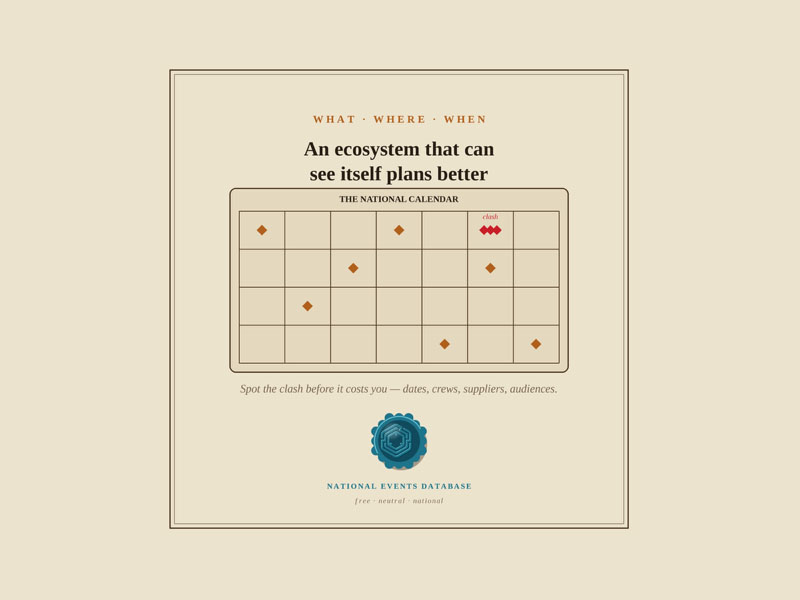
What the festival cancellations tell us – and why a shared, strategic view matters.
Most people outside the industry don’t realise how fragile the live-events landscape has become. The Association of Independent Festivals (AIF) does important work tracking it – including a running record of the UK festivals that have cancelled, postponed or wound up for good. It’s a sobering barometer of the sector’s health and it prompted this piece.
Read down the list they’ve published and the same causes repeat: inflation and production costs, supply-chain and transport pressures and the cost-of-living squeeze on ticket sales. Weather, licensing, lost sites and volunteer burnout do the rest. Those are structural pressures and it would be glib to suggest a mapping tool solves them.
But not every pressure is unavoidable.
Look again and a second category appears alongside the structural one – the avoidable kind:
These are coordination problems. And coordination is precisely what a shared, strategic view of the calendar can improve.
That is the whole idea behind the National Events Database (NED): a free, neutral map of what is happening, where and when, across the UK. Not to rescue anyone from inflation, but to give the whole ecosystem a longer planning horizon and a shared reference point – a common operating picture – to work from.
| Who | What the shared view gives them |
|---|---|
| Organisers | Choose dates that don’t collide with the event down the road; see where audiences, crews and suppliers are already committed; plan further ahead with confidence. |
| Venues | Understand the wider calendar around a booking and the demand pressures either side of it. |
| Local authorities & SAGs | See the whole landscape, not just individual applications – and spot the peak-pressure weekends before they arrive. |
| Emergency & public services | Anticipate where resources will be stretched across a region on any given date. |
| Suppliers & the supply chain | Foresee clashes for crew, transport and hire stock – the pinch points that quietly raise everyone’s costs. |
| Fringe & satellite events | Align to anchor events and busy weekends – sharing audiences, extending the programme and building a bigger collective draw, rather than competing blind. |
The real prize is time. Most avoidable clashes are only avoidable if you can see them early – while dates are still moveable, before deposits are paid and marketing is committed. A national picture that reaches out over seasons, not weeks, turns late surprises into early, manageable choices. That is what an extended planning horizon buys: foresight.
A shared calendar does more than keep events apart; it helps the right ones find each other. When the map is visible, fringe and satellite events can align themselves to anchor events – clustering around a festival or a busy weekend to share audiences, extend a destination’s programme and build a bigger collective draw. Deconfliction avoids the collision; alignment creates the constellation. A village’s fringe, a town’s ‘weekend of’, a promoter’s satellite show – all far easier to place well when everyone can see where the draw already is.
The NED is no panacea. It won’t cure the hard economics of putting on an event and it doesn’t pretend to. It is supportive, neutral infrastructure, for a sector that needs to see and understand itself.
When information is fragmented, clashes stay invisible until it’s too late.
When it’s shared, everyone plans better – and some of those better decisions are the difference between a viable event and an avoidable collision.
The NED is free and open to events and venues of every size – a village fete or a city festival and crucially – whether or not you fall within Martyn’s Law. If you’re planning for 2027 and beyond, the most useful thing you can do for your own event and for everyone planning around you, is to put yourself on the map. Shared clarity strengthens everyone.